Stigma rarely announces itself. It hides in a whiteboard that strains the eyes of a student struggling to keep up, in a nickname shouted across a marketplace, in the quiet pity of a family member who means well but smothers independence. For persons with albinism in Nigeria, these accumulated indignities, visible and invisible, have long defined daily life. A new campaign is now pushing back, and it is doing so not with statistics alone, but with poetry, music, and the unfiltered testimony of those who have lived the experience.
Poet and musician Ruth Mahogany, in collaboration with the Albinism Association of Nigeria, known as AAN, has launched a 21-day social media campaign running from February 24 to March 16, aimed at creating public awareness and affirming the dignity of persons with albinism in Nigeria. The campaign is funded by Foundation Pierre Fabre and operates on two tracks simultaneously: a medical outreach providing check-ups and assistive materials to persons with albinism, and a daily digital content programme deploying spoken word and storytelling to challenge the myths that continue to circulate around the condition.
Central to the campaign is a five-minute spoken word video titled ‘White Fire’, created by Mahogany’s Big Feline Agency in collaboration with AAN. The video opens with a clinical but necessary clarification, one that the campaign’s organisers clearly believe is still not widely understood. Albinism, the video explains, is a genetic condition affecting the body’s production of melanin, the pigment responsible for the colour of skin, hair, and eyes. A child with albinism is born only when both parents carry the albinism gene, even when neither parent displays visible signs of the condition.

That biological fact matters enormously in the Nigerian context. The persistence of supernatural explanations for albinism, linking the condition to curses, witchcraft, or punishment, has contributed to discrimination, social exclusion, and in the most extreme cases across parts of sub-Saharan Africa, physical violence. In Tanzania, Malawi, and other countries in the region, persons with albinism have been murdered for their body parts, which are falsely believed by some to carry magical properties. Nigeria has not been immune to harmful folklore surrounding albinism, and the campaign is deliberate in its effort to replace mythology with medical fact.
According to data from the World Health Organisation, albinism affects approximately one in every 5,000 to 15,000 people globally, though the condition is significantly more prevalent in sub-Saharan Africa, where estimates place the figure closer to one in 1,400 in some populations. Nigeria, with a population exceeding 220 million, carries a substantial number of persons with albinism, many of whom navigate a healthcare system poorly equipped to address their specific vulnerabilities, particularly the elevated risk of skin cancer resulting from low melanin levels and prolonged sun exposure.
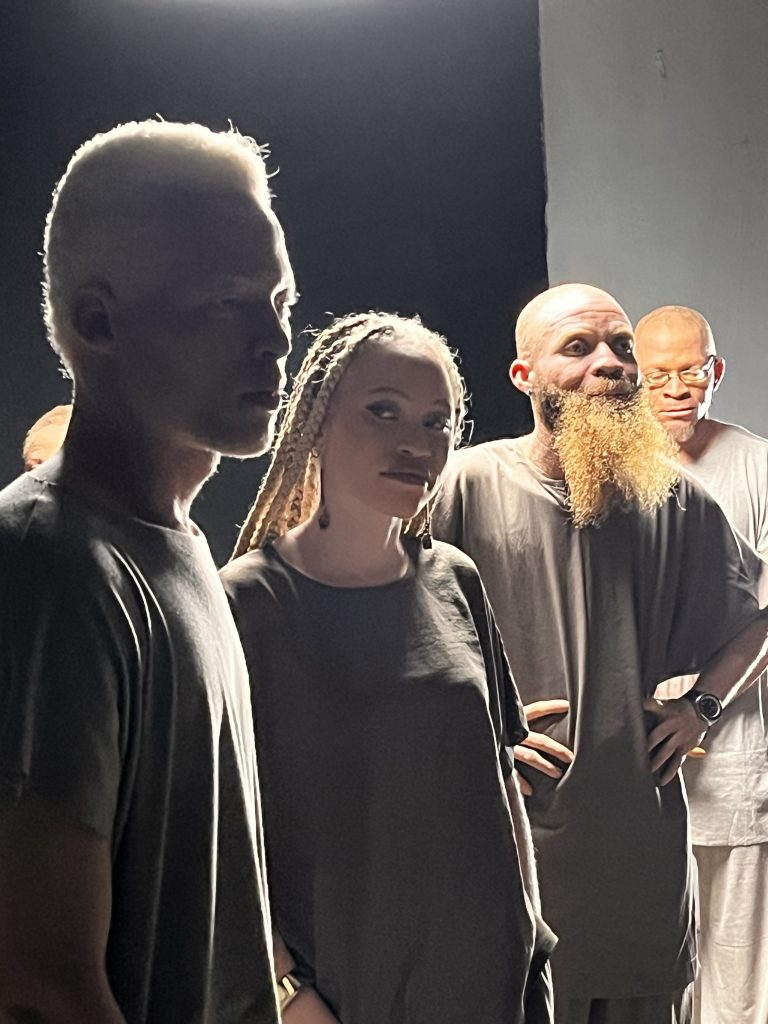
‘White Fire’ centres two individuals with albinism, Deborah Obanor and Mc Wyte, who narrate their lived experiences directly to camera in spoken word form. Their testimonies are specific and unsparing. They describe being addressed by names such as ‘Oyinbo Pepper’, ‘Afin’, and ‘Anyali’, terms deployed not as affection but as othering, as markers that separate and diminish. They speak of bullying, of being ignored, of discrimination in spaces that should have been safe.
Among the more quietly devastating details is the whiteboard. In classrooms and offices across Nigeria, the standard whiteboard is used without a second thought. For a person with albinism, whose visual impairment is a common and often underappreciated accompanying feature of the condition, a whiteboard poses a serious and daily obstacle. Obanor and Mc Wyte describe having to work five times as hard as their peers simply to read what is written on it. This is not a dramatic injustice. It is an invisible one, the kind that accumulates over years of schooling and professional life, slowly eroding confidence and narrowing ambition.
The campaign does not stop at external indignity. It also surfaces the internal damage: low self-esteem, the undermining of independence that comes from families whose overprotection, however well-intentioned, communicates that a person with albinism cannot manage their own life. These are the subtler mechanisms by which dignity is eroded, and they are the harder ones to address through policy alone.
The decision to anchor the campaign in artistic expression rather than conventional advocacy materials was deliberate. The executive director of AAN, Dr Bisi Bamishe, explained the reasoning plainly. Beyond the proven power of the arts to reach emotions that facts and figures cannot easily access, the association wanted to celebrate what persons with albinism bring to the world, their talents, their resilience, and their full humanity.
“Using an art form like music, spoken word, or visual arts makes the message relatable, memorable and engaging in ways that facts and statistics alone cannot achieve,” Bamishe said. She added that partnering with an artist also makes it significantly easier to reach younger Nigerians, through creativity, emotion, and storytelling, audiences that tend to disengage from conventional public health messaging.
Mahogany, who serves as executive director of Big Feline Agency, described the inspiration for ‘White Fire’ as rooted in the central themes that run through her broader body of work. “I am deeply inspired by persons with albinism. I wanted a collaboration that will showcase the heights of excellence and beauty while reflecting their authentic experiences. Because being different doesn’t affect the heights of greatness a person can achieve,” she said.
The preparation for the video was itself part of the campaign’s philosophy. Obanor, Mc Wyte, and several other persons with albinism were coached in spoken word techniques before a professional studio session and video shoot. Mahogany described the environment as deliberately affirming. “There is a dignity in co-creating something beautiful in a loving and respectful environment,” she said.
Obanor confirmed that the production process matched its stated values. “I learnt a lot in the process of creating the video. Regardless of my being a person with albinism, I am a creative. I never felt like I wasn’t given equal opportunity in terms of suggesting ideas or performing my ideas,” she said.
The AAN was founded as the primary civil society body representing persons with albinism in Nigeria and has worked across healthcare access, legal protection, and public education for years. Its collaboration with Foundation Pierre Fabre, a French pharmaceutical and cosmetics group with a long-standing commitment to dermatological health and vulnerable communities globally, brings financial structure to a campaign that might otherwise have relied on voluntarism alone. Foundation Pierre Fabre has supported similar initiatives in other African countries, particularly in the area of skin health for persons with albinism.
The timing of the campaign, running from the final week of February through mid-March, places it in proximity to International Albinism Awareness Day, observed annually on June 13, a date established by the United Nations General Assembly in 2014 following years of advocacy by organisations working on behalf of persons with albinism across Africa. The June observance was created in direct response to documented killings and mutilations of persons with albinism in countries including Tanzania, Malawi, and Mozambique. Nigeria has not experienced those extremes at scale, but social discrimination, healthcare neglect, and institutional invisibility remain documented problems.
The choice to run the campaign on social media reflects the current realities of Nigerian public discourse. With over 37 million social media users and a deeply online youth population, digital platforms offer reach that traditional media cannot match for sustained, daily engagement. The campaign’s structure of daily dignity-affirming posts, accompanied by the anchor video, is designed to accumulate impact over 21 days rather than deliver a single message and fade.
Campaigns like this one do not resolve structural problems on their own. Persons with albinism in Nigeria still face inadequate access to sunscreen, hats, and protective clothing on any consistent public health basis. Ophthalmological services to address the visual impairments that accompany albinism remain underfunded and unevenly distributed. Legal protections against discrimination, while technically available under Nigeria’s broad constitutional framework, are rarely invoked on behalf of persons with albinism because enforcement mechanisms are weak and awareness among legal practitioners is low.
What ‘White Fire’ and the broader 21-day campaign attempt to do is shift the cultural soil in which these material failures grow. When a young person with albinism watches Deborah Obanor perform her story with confidence and craft, when a parent hears the genetic explanation of albinism clearly articulated for the first time, when a teacher realises that the whiteboard at the front of the class is not a neutral object, something moves. It may not change policy overnight. But it changes what is possible to imagine.
That is what art does, and in the hands of Ruth Mahogany, AAN, and the individuals at the centre of ‘White Fire’, it is being asked to do serious